
Construction Industry News


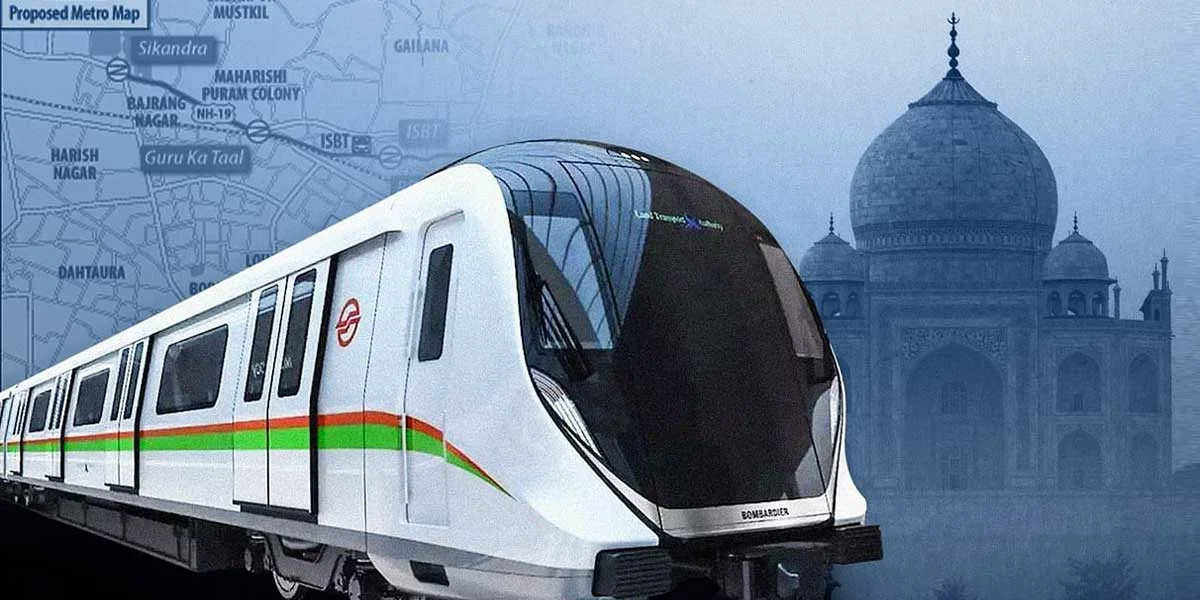
In Agra, home of the Taj Mahal, the population is increasing, putting pressure on infrastructure. As a result, this third largest city in Uttar Pradesh was in dire need of adequate infrastructure to allow for better connections throughout the city.
To address the transportation issues, the Uttar Pradesh Metro Rail Corporation (UPMRCL) launched the Agra metro project, a 29.40 km rapid transit system with 2 lines and 28 stations. RITES Ltd. was tasked by the government of Uttar Pradesh to prepare a detailed project report (DPR) on a rail-based public transport system in Agra. The project received cabinet approval on February 28, 2019, and the Supreme Court approved its construction in July 2020. Agra Metro was formally inaugurated on March 8, 2019 by Prime Minister Narendra Modi and the Prime Minister of the State, Yogi Adityanth, via a video. conference.
Line 1 is currently being built at an estimated cost of Rs. 8,379.62 crores. Construction of Line 1 is expected to be completed in 2025. A loan of EUR 480 million from the European Investment Bank and a joint venture between the governments of India and Uttar Pradesh provided financing for the project. The metro rail system in Agra will have 2 corridors, the first of which will be 14 km long and will connect the Taj East Gate and Sikandara with 6 elevated stations and 7 metro stations. The second 15.40 km corridor with 14 elevated stations will be constructed between Agra Cantt and Kalindi Vihar. The proposed intersection of the corridors is at St. John's College.
The priority corridor covers the distance between Jama Masjid and Taj East Gate (7 km) via 3 underground and 3 elevated stations. The Agra Metro has so far been divided into four packages, one of which is yet to be finalized. Contractors for packages 1, 2 and 3 are Sam (India) Builtwell Pvt. Ltd., Afcons-SAM JV and Lisha Engineers, respectively.
The general consultancy contract for phase 1 has been awarded to TYPSA-Italferr JV.
The metro route stretches for 29.40 km and connects major tourist destinations such as Taj Mahal, Agra Fort and Sikandra with railway stations as well as ISBT, Raja Ki Mandi Railway Station, Medical College, Agra Cant Railway Station, Collectorate and Sanjay Place. Agra metro stations will be on display advanced technology and automated systems, as well as representations of the city's history and beauty. The Agra Metro rail project is estimated to benefit the city's 26 lakh population and provide convenience to 60 lakh tourists visiting India each year. This eco-friendly transit system will help reduce traffic congestion and provide a cost-effective transportation network in the historic city of Agra.