
Construction Industry News


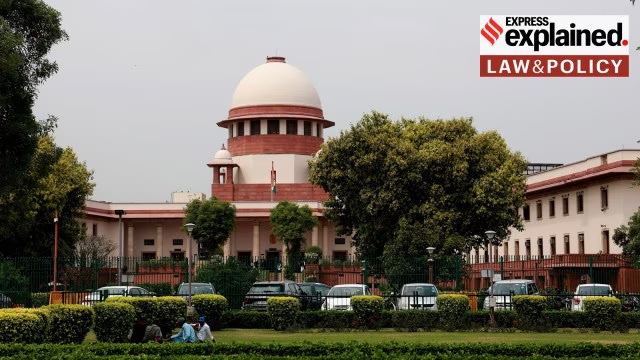
In a landmark judgement, a seven-judge Bench of the Supreme Court on Thursday (August 1) reframed how the Scheduled Castes (SC) and Scheduled Tribes (ST) quota may operate — for the very first time since reservations were introduced in the Constitution in 1950.
In a 6:1 ruling, the Bench headed by Chief Justice of India D Y Chandrachud permitted states to create sub-classifications within the SC and ST categories for the purpose of according wider protections — through fixed sub-quotas — to the most backward communities within these categories. This overturns the apex court’s 2004 decision in E V Chinnaiah v State of Andhra Pradesh, in which it had held that the SC/ST list is a “homogenous group” that cannot be divided further.
The ruling had six separate opinions — five in favour of sub-classification, and a lone dissent by Justice Bela Trivedi.
Article 341 of the Constitution allows the President, through a public notification, to list as SC “castes, races or tribes” that suffered from the historical injustice of untouchability. SC groups are jointly accorded 15% reservation in education and public employment.
Over the years, some groups within the SC list have been underrepresented compared to others. States have made attempts to extend more protection to these groups, but the issue has run into judicial scrutiny.
In 1975, Punjab issued a notification giving first preference in SC reservations to the Balmiki and Mazhabi Sikh communities, two of the most backward communities in the state. This was challenged in 2004 after the apex court struck down a similar law in Andhra Pradesh in E V Chinnnaiah.
The court had held that any attempts to create a differentiation within the SC list would essentially amount to tinkering with it, for which the Constitution did not empower states. Article 341 only empowers the President to issue such a notification, and Parliament to make additions or deletions to the list. The court also said that sub-classifying SCs violates the right to equality under Article 14
Based on this ruling, in 2006, the Punjab & Haryana High Court in Dr. Kishan Pal v State of Punjab struck down the aforementioned 1975 notification. However, the very same year, the Punjab government again passed the Punjab Scheduled Caste and Backward Classes (Reservation in Services) Act, 2006, reintroducing the first preference in reservations for the Balmiki and Mazhabi Sikh communities.
This Act was challenged by Davinder Singh, a member of a non-Balmiki, non-Mazhabi Sikh SC community. The HC, in 2010, struck down the Act, leading to an appeal at the Supreme Court. In 2014, the case was referred to a five-judge Constitution Bench to determine if the E V Chinnaiah decision had to be reconsidered.
In 2020, the Justice Arun Mishra-headed Constitution Bench in Davinder Singh v State of Punjab held that the court’s 2004 decision required reconsideration. The ruling noted that the court and the state “cannot be a silent spectator and shut its eyes to stark realities”. Crucially, it disagreed with the premise that SC are a homogeneous group, saying there are “unequals within the list of Scheduled Castes, Scheduled Tribes, and socially and educationally backward classes.”
But since this Bench, like in E V Chinnaiah, comprised five judges, a seven-judge Bench heard the issue in February 2024. Here are the key issues which were before the Bench.
Article 341(1) of the Constitution gives the President the power to “specify the castes, races or tribes” in a state, which shall “for the purposes of this Constitution be deemed to be Scheduled Castes in relation to that State or Union territory, as the case may be”. Following such a notification, Article 341(2) states that only Parliament can include or exclude “any caste, race or tribe” from the list of SCs.
The court in E V Chinnaiah held that SC must be treated identically since the Constitution envisaged the same benefits for them, without taking into account their individual relative backwardness. In Thursday’s judgement, CJI Chandrachud rejected this premise, stating that “The inclusion [in the Presidential list] does not automatically lead to the formation of a uniform and internally homogenous class which cannot be further classified”.
The CJI termed the Presidential list of SCs a “legal fiction” — something that does not exist in actuality but is “treated as real and existing for the purpose of law”. A Scheduled Caste is not something that existed before the Constitution came into force, and is recognised so that benefits can be provided to communities in the list. CJI Chandrachud said this legal fiction cannot be “stretched” to claim that there are no “internal differences” among SCs.
Issue 2: Can states ‘tinker’ with or sub-classify the Presidential list?,
Articles 15(4) of the Constitution gives states the power to make “any special provision” for the advancement of SCs. Article 16(4) gives states the specific power to provide “reservations of appointments or posts in favour of any backward class of citizens which…is not adequately represented in the services of the State'.